Pages

Tuesday, 28 February 2017

The Flower of Civilization

It baffles me when apparently “intelligent” people, folks who claim to be educated, and so forth, tell me that we are living in the highest expression of “civilization.” That we’re at the peak of greatness – far surpassing any cultural or civilizational achievements of past epochs. When they tell me such glowing things, especially in the West, my eyes start to glaze over... then I know their egos are at full throttle -- they're proud of something they did not achieve. It's their “badge of honor” to be living at the zenith of materialistic culture, and they have no qualms in taking credit for it. 

The usual spiel goes like this: We in the West are the most advanced people on Earth. We have created the most wealth in History, we live longer than anyone ever before. We have the most gadgets and toys, and we enjoy the greatest creature comforts with the least amount of effort, etc., etc. 
  
The last bit is, of course, both revealing and true at the same time. But when I ask them to provide some evidence, some proof of this overwhelming superiority we possess vis-a-vis our ancestors, no one wants to take into account the downside...

We also have more and longer wars than our ancestors. We also kill and starve children as a necessity (to maintain our superiority, I assume), famines and environmental destruction is now worldwide and not local, refugees and immigrant displacement has never been greater. Neither has racism, violence, cancer and illnesses been so rampant. Never has culture, art, and sicence been so devoid of spirit or originality. Who is painting a 'Mona Lisa' today? And, when the obvious physical and intellectual weakness of the modern herd-animal is laid bare in the light of day, there is little to recommend our exceptional "superiority." To all this they have nothing to say...

When I ask them to define what they mean by “civilization,” I invariably get something like this (although not always this succinctly): “the behavior and beliefs that characterize a society.” 

But of course, when I tell them that sounds suspiciously like the definition of “culture,” and not “civilization,” then I do get slightly better revisions to the definition, although not particularly good ones... Because then, people react to the word Civilization (with a capital ‘C’) and they throw everything into the definition, such as... “A society reaching an advanced state in the arts, science, industry, and government has been reached.”

Advanced in compared to what? Isn't that a barely a glossed over value judgment? So much for a priori judgments... The key word seems to be “advanced state” or something of that ilk. The value judgment that “advanced” is better somehow than what has gone before, and therefore the general illusion of “progress” seems to be the hallmark of Civilization.

Is this satisfactory? It’s probably too close to the textbook definition, and it barely rates as a small snack... We’re not looking for a dictionary entry to answer the question. The problem with confusing “culture” with Civilization is neither new nor unusual, but it’s revealing.

Naturally, I don’t get as much of this as I used to... but, I still do, especially from old friends, who should know better, since they lived through parts of the last millennium, which was a time when one could close one’s eyes to the obvious – we were mildly distracted then by the West’s technological superiority vis-à-vis the rest of the world (that certainly isn’t the case today). I supposed the lack of enthusiasm has its root – things just aren’t as peachy-keen as the purveyors of propaganda would have us believe. Things simply aren’t as “glowing” as they were but a few years back... even for folks who lived in relative wealth and comfort (all the Karma does end up coming around, doesn’t it?).

Still, even philosophically, existentially, abstractly, they claim that we’re the “Top of the Pops,” although with less enthusiasm than formerly. Well, I beg to differ... The fact that now every two-year-old owns a Smartphone to stare at in their play pens, doesn’t rightly smack me of “cultural superiority,” “class exceptionalism,” or “human advancement” as far as culture or Civilization are concerned. Rather the opposite comes to mind... in other words, decadence or decay, and inevitable decline.

From Roots to Flowers

Hate to bring in “reality” into the picture – most people are offended when I do that.

But let us look at an example from the real world – the world of plants – to get an idea of where we stand in civilizational terms. I’m going to go against my better instincts and agree wholeheartedly with my friends’ opinion about our place in the “evolution” of Civilization.

Let’s assume the we – the West – since we can’t have the least consideration for other “inferior” Civilizations like the Hindu, Persian, Egyptian, Babylonian, Incan, Mexican, Polynesian, et al... anything that predates us is toast! (Or so does our current herd-animal believe).

The West is then the “flower” of Civilization, and arguably the flower is the sum of all the plant has achieved in its “evolution,” or better said, its existence. The flower radiates out its color into the world to delight and cajole (kind of like Hollywood does for the current “world-order”).

But what went into this flower in order that it my dazzle us with its fragrance, color, and one would dare say, luminosity? What attracts the bees and the butterflies that it can then “go on giving” pleasure and delight in the future (through pollination, although that’s not what happens in the flower in actual reality, but let’s just assume that it does for the purposes of our example, or metaphor, if you will).  

If we have ever observed a flower in its field of splendor in spring, we know that a couple of weeks later, it doesn’t look so hot (unless the flower is in a garden and tended by someone who has a green thumb). In the field (in Nature), the flower is the first to go... it withers with the onset of the days, it decays, discolors, and then its petals drop off (like the leaves the petals once were).

When the flower droops or is gone, usually, the leaves and stems continue, for a time, but the last to go – what we don’t see underground – is the root. The root is still alive, long after the rest of the plant has withered away. In fact, a capable gardener can revive a plant from the root alone, not just from a sprig, or graft.

Too bad this can’t be done with a Civilization...

So, I tell my friends that if you’re not a good gardener, you can forget your vaunted Western Civilization... it’s had its flowering, it’s now ready for the compost heap. The people who were supposed to be watering, trimming, and singing, failed to do so... they got lazy. They left it all to the Government and the Bankers to do for them... It turned out that the crooks weren’t gardeners at all – they just plucked the flowers out and left everyone else with a dried-out stem, no leaves, and a rotten root!

The stewards we left behind in the garden so we could go stroke our egos, sprawled on the sofa, looking at ourselves in the little screens, admiring our “beauty” and “intelligence,” weren’t very good gardeners, were they? Why does this sound like a parable to me?

Yep, we fell asleep and we got ripped off... it ought to be a lesson... but... we can’t pry ourselves from the little hand-held mirrors long enough to hit the toilet... Best not think at all – if one can get away with it... sleep right through the mess...

Civilization Lost...

What is Civilization? At this point, to ask such may be tantamount to closing the barn door after the cow’s gone... Our prejudice of the past tells us that if you look at it historically, it wasn’t much of a “paradise”. I’m not so sure... It certainly had less wars, less starvation, less of the things that brought our little flower to wither and decay... But we can’t remedy the past, we can only get to work on what’s left of the garden... Sadly, there’s not much of that either.

What is Civilization? One can ask this today, almost in the same way that one may ask what a dinosaur is... I mean, was. Are we even living in a Civilization? Or is that just a nice, polysyllabic word to banter about to sound more “erudite,” more “cultured”? Don’t be too quick to jump to conclusions... just because the Greeks started something, it doesn’t mean that it’s not “all over now baby-blue”...

Is Civilization the finale of a Culture, as Oswald Spengler (1880-1936) postulated? Spengler was the author of “The Decline of the West,” possibly one of the most revolutionary works of the early 20th Century (written before WW I, and published immediately afterward). Not surprisingly, at the beginning of the last millennium (the last time human beings could actually think), there were quite a few ground-breaking works, including Einstein’s Special Theory of Relativity, etc.

Modern herd-animals seem to hate Spengler (that includes most of Western “academia,” or what’s left of its desiccated petals). Is it because he’s odious? In other words, some Nazi knuckleheads read him, so now his thoughts are somehow “evil”? Or, is it because he says things that are uncomfortable for the decadent herd-animals of today to hear?

Frankly, I think it's because he looks like "Dr. Evil," and all that's missing is "mini-me"...

To give you an idea of how prescient the “The Decline of the West” was, here are a couple of quotes from it, that ought to make one stand up, go for a long, long walk... and, keep following the little furry lemmings...

“Through money, democracy becomes its own destroyer, after money has destroyed intellect.” -Oswald Spengler-

Welcome to 2017! Welcome to the Ponzi scheme par excellence... the craven, new world of Zuckerberg-media (ought to be properly labeled as “sucker media”), wherein so-called “presidents” and “leaders of the free-for-all” sit with their excessively overwrought asses on the red-button, insulting other nuclear-armed leaders through Twitter.

We are so “advanced” that it is also the preferred “tool” for developing and implementing of national and international policy... Any “idea” that requires more than 140 characters to express is no longer considered, much less though out; i.e., any actual idea... What idea could possibly be developed and explained in 140 characters? It’s even hard to insult someone properly with a barrage of four-letter words with that limitation. I find it constricting as hell. Only a constipated, anal-retentive culture-society could possible flourish with Tweeter as its “commons.”

In the meantime, what are the rest of the folks doing while this is going on? Sleeping through the whole damn nightmare...

“Formerly no one was allowed to think freely; now it is permitted, but no one is capable of it any more. Now people want to think only what they are supposed to think, and this they consider freedom.” -Oswald Spengler-

Normally, I’m not much for quoting quotes... but since we’re doing “quotes” today, might as well nail it with another eminent philosopher’s point of view on the subject of “thinking” – someone of a whole different stripe than Spengler so that there should be less squealing from the gallery... Usually, as things get closer to universal truths, they lose their identifying stripes (their convenient labels) all together.

“Thought is not a gift to man but a laborious, precarious and volatile acquisition.” -José Ortega y Gasset- (1883-1955) Spanish philosopher.

Since the middle of the 20th Century, “thinking” (by which I mean “critical thinking,” as it was then called, or “free thinking,” as it was labeled in the 17th - 19th Century) is no longer practiced. It has become “passé,” something for nerds to do (although they – the “nerds” – are incapable of it also). Scientists are the least capable of thinking... Again, “critical thinking,” is not counting, adding, multiplying, or fooling around with abstract mathematical formulas... these are not “active” living thoughts going to the brain.

As most of you know, the Ancient Egyptians called thinking, “wisdom-of-the-heart” or “knowledge-of-the-heart,” since what actually does the “work” of thought is not the brain but rather the heart organ. When a thought reaches up to the head; i.e., gets through the entire body, from the ground up – then we can start talking about something related to “thought”.

Naturally, this mystery of thinking, and how thoughts originate from our surroundings, from the Cosmos itself (from the living planet we stand on, etc.), is not something anyone has the least inkling about. Of course, I include myself among the lot of blockheads that can’t think properly, and who is completely ignorant on how the process actually works. The “how” of things is way harder than the “what” of things.

Yet, what is obvious even to a dunderhead like me is that thinking is NOT going on either at an individual or at a species level on this planet... And, I would welcome anyone to prove otherwise... (now, THAT would be a ray of hope, or would that just be more “fool’s gold”?

Thinking Is ‘Verboten’!

The folks that make me laugh the most are those who debate IQ numbers, and then apply them to “races”. As if IQ factoring were some kind of “empirical” proof of something, like intelligence... I realize that human beings are incapable of thought, and can therefore only “count,” so the claim is that if the subject of the IQ test can “compare” and “contrast” then they are more “advanced”. Well, comparing and contrasting are really only more counting. It’s a counting without numbers, but in the end, one adds or subtracts what one “likes” or “dislikes” from the whole (or whatever one is asked to compare and contrast on the test itself). But chimpanzees can do that too... yet, they can’t think either. Talk about nutty. It’s the “Sesame Street” approach to “thinking”.  


Frankly, IQ tests deal only in abstractions, and speaking of which, so is the concept of “race” – a total abstraction. The difference in DNA between humans and chimpanzees (hate to pick on the poor criters) is less than 2%. There are hardly any marginal differences between humans of different origin (geographical locations) on this planet. Yet, that’s what all the hate is about...

“Those who talk too much about race no longer have it in them.”
-Oswald Spengler-

But the fact that there is no such thing as race falls on deaf ears in this age of non-thinking, and sleep walking through History. Even by the abstract bent of modern science, no one has found yet a “race” gene. Yet, skin color does bother some people... and this “dislike,” is what all the hate is about. Wonder what chimpanzees have to say about that... (“Thank God we got off that lousy branch of the evolution tree!” Or words to that effect are often heard calling from the trees)

Now, the application of “feeling” to thinking in humans could elevate the form to that of actual thought (by bringing the heart into the process of lifting this heavy stuff upwards toward the brain). But humans no longer have the stamina for the heavy lifting involved. At one time, in the time of the Black People, they could lift two-ton blocks every two minutes, but today, we’re considerably weaker and more feeble creatures (the result of centuries of decadence, both physical and intellectual).

It is still possible to think? In our couch-potato culture it seems unlikely... Is thinking akin to a muscle in our bodies? If it is, then through sheer lack of use, it has become atrophied. As Ortega y Gasset said, a gift has been given us, but it was too “labor intensive,” and we just got tuckered out. We have chosen the sofa instead... Though the ability to think may be innate in our species, it’s not exactly a given, it must be worked at (will-to-power has something to do with it, I'm sure).

Here is another Oswald Spengler “pearl” of wisdom, demonstrating what our level of “thinking” amounts to, and thus revealing the decline and “end” of a Culture (culture form or group) and therefore, a Civilization:

When the ordinary thought of a highly-cultivated people begins to regard 'having children' as a question of pro's and con's, the great turning point has come.

If one assumes history morphologically, as Spengler did, Civilizations must have a “life-cycle,” and, we know when and where a life-cycle is over...

Every Culture had its Civilization, according the late German historian. Civilization seems to be the obvious destiny of a Culture. “Civilizations are the most external and artificial states of which a species of developed humanity is capable,” Spengler wrote in his famous “The Decline of the West”. It even makes sense.

This is not to say that one agrees with everything he says (although from a materialist’s point of view he covers all the angles). We do have our own little “likes” and “dislikes,” don’t we? But, we live in that ersatz "Tweetie" world where virtual reality is the only reality... We do cling to our a priori judgments and prejudices, what we’d rather believe than look at what is really there...

At the very least, Oswald Spengler was far more stimulating in his thinking than most other historians, even the venerable Arnold J. Toynbee, who practically stole Spengler’s idea of the morphology of civilizations. But alas, modern historians are just propagandists, with very few exceptions (e.g., the late Howard Zinn), since most prefer to simply lacquer over the “convenient fable” and regurgitate it as History. That’s the way it’s studied and disseminated in our society today (through universities and the media), like a feel-good ad on TV.

Perhaps I’ll take up this matter in coming posts, since it’s full of portent (like a good novel) and given our current malaise, it seems only fitting to determine if we are at the “finale” of our Civilization, or as my friends wish to believe, at the very “apex” of it. In the meantime, one last jab... a left-cross to the chin.

“To-day we live so cowed under the bombardment of this intellectual artillery (the media) that hardly anyone can attain to the inward detachment that is required for a clear view of the monstrous drama. The will-to-power operating under a pure democratic disguise has finished off its masterpiece so well that the object's sense of freedom is actually flattered by the most thorough-going enslavement that has ever existed.” -Oswald Spengler-

Inward detachment is certainly necessary – the first step toward clear thinking. But who has the stamina for that today? Who is going to do Yoga in order to start to think? Why bother? When it’s so much comfier and cozy to cuddle up with that “Smartphone” or other hand-held device on that big couch... and let it suck all the brains out of ya’... Ahh! I can hear the collective sigh of relief (“Now, I can stop thinking and get comfortably numb!”)


Friday, 30 September 2016

Back to School...

Once the autumnal equinox arrives, and the days grow both shorter and cooler, everyone is back at school... Millions return complacent to their day care-like “prisons,” under the tutelage of the panderers of blandness and mediocrity that are so characteristic of modern education – especially at the university and “higher” academic levels in the private sector. Impressionable young adults return to the mind-numbing drill that crushes their spirit, blunts their enthusiasm for the world, and kills their imagination. In other words, back to school! 


In times past, this sorry state of affairs didn’t exist. And, the further back in time we go, let’s say the Iron Age or earlier, what we call school, or even education, had a completely different character than it has today. Unlike what our Corporate purveyors of mediocrity tells us, people 4,000 years ago were not as illiterate and uneducated as we are today... They had far more educational opportunities than in our present times of illusory “free choice” and the debt bondage students are subjected to (with the latter, the students’ parents are in hock for the principle and interest also).

Granted, since the golden age of Greece, 9th to 4th Century B.C., education, as a whole has been neglected, curtailed, and eventually restricted to a few elites (as it is today). But even the decadence of the Greeks, and later the Romans, was not the standard of earlier times, when writing was in its heyday.

I realize that the common fable runs counter to what I have just exposed. Academicians insist, because they’ve been drumming this nonsense into us for at least two hundred years now, that throughout History no one could read or write (because to them, History, since time immemorial, is one single, unchanging bore). Since every assessment and judgment about the past is based on present prejudices (a priori judgments), the reasoning goes that knowledge, or information, is power. And, because our current leaders are a bunch of sniveling girlie-men, they figure that by keeping the population ignorant and stupid, in other words, by lying to them, they’ll retain all the power (esp. the political power). Can anyone deny that this is so?

There are few things that are further from the truth than this particular lie... that in the past everyone, except for the scribes or the high priests, were illiterate (Kings, on the whole, especially in Europe, have been illiterate until a century or so ago). This seminal lie, whose purpose is to make us modern folk appear somehow “exceptional,” if not exceptionally lucky, is intended to prevent us from having any interest in matters past... and to thus have us both despise and ignore all previous human wisdom. Because any impartial survey of what people in the past actually knew, would dwarf what we know today...

Take whatever art or wisdom you choose, and today we live in the darkest age in all of human history, an age filled with superstition and outright lies passing themselves off as “truths,” an age of pygmies instead of giants. The only thing one can point to as “advanced” in this Dark Age, is the equally dark “technology” that forms the new materialistic religion of today. If that is the only virtue of our times, and of our civilization, that pretty much says it all... since technology is precisely the dehumanizing driver that has turned us into superstitious Neanderthals in the first place.

We Don’t Do That at KAOS

Have we forgotten our prime directive again? Ignorance is our badge of pride, conceit our attitude, and brazen disregard and carelessness our modus operandi. That’s how exceptional we are! Did I neglect to mention laziness, which is the encapsulation of all the preceding traits? Without ignorance manifested as laziness, where would Monsanto (insert your favorite "Criminal Class Conspiracy" here!) be today? Out of whose pockets would the sugar and trans fat industries get the bulk of their revenues?


Thanks to the reversal of values inherent in History (in the passing of Time itself, if not of ongoing Evolution), we have taken on all of the past’s worse tendencies and assumed them as virtues. Especially all of the decadent tendencies apparent since the 15th Century A.D., since our vaunted Renaissance period. The “glorious” Renaissance was nothing more than the end of something, like the Middle Ages, it was the beginning of the strictly abstract, limited intellectual view of the world we hold today. We can begin to analyze History along evolutionary lines only once we accept that every age has its Leitmotif. What I call “evolutionary streams” or tendencies (something I’ll delve into with more detail in the future). Since the 15th Century, few people have been lucky enough to see the gods... much less admit to their existence... Doesn’t that seem odd to anyone?

We moderns like to think that all that talk about “the gods,” and all that polytheistic gobbledygook that ancient people went on and on about, was some kind of delusion, or worse, an out and out lie (we assume it was all contrived by the priests to placate the masses, and keep them from rebelling).

It’s typical modern non-thinking and wrongheadedness to assume so, however... Why would the people of the past lie? What was their compulsion? To impress whom exactly? Certainly not God, whom they saw manifested in myriad ways in everything around them – from the stars, to the wind, to the trees and animals, even to the rocks and stones! Lies are a modern confection, just like “high technology.” It should not surprise us then, when the demon or demigod that brought us lies also brought us high technology.

Knowing that every person had a personal and collective relationship with a living god should not only make us jealous, it should make us stop and think for a change. Shouldn’t the fact that you don’t see God anymore give you pause?

Well, Freddie wasn’t so timid, or loathe to speak the truth, when he pronounced a certain deity done for. If God’s not around, he must be either be MIA, or Dead... or both! Given our so-called civilization’s maturity, he was not wrong... If gods breed civilizations, then a dead and decaying one no longer has a caretaker, now does it?

The Literacy Rate Today and Five Thousand Years Ago

Aren’t our modern misconceptions, superstitions, and “damnable lies,” just wonderful? I mean statistics... I always hate to have to resort to lies to prove a point, but with science being as dead as God and all, what’s the alternative? Certainly not the UN and UNESCO... but what else is there?


According to the above authority, the global literacy rate for all people aged 15 and above is 86.3%. The global literacy rate for all males is 90.0% and the rate for all females is 82.7% (funny how the much smarter sex is still behind – so much for feminism, I guess). For the nationalist and racists among us, the statistics are slanted to their way of thinking too... Africa’s literacy rate hovers around 64% and in the “developed nations” have a 99.2% literacy rate. I personally don’t buy this last statistic, but there it is, the only clue as to our vaunted “superiority” as a race and a nation. And finally, according to UNESCO, there are “only” 781 Million people living on our planet who are illiterate – in other words, many times the reputed population of the Late Bronze Age! Go figure!

Was global literacy in the Late Bronze Age actually lower than it is today? I doubt it. If it was, it was probably only slightly “statistically” lower. Writing by that time had been around a while, maybe a few thousand years. And by contrast, writing in the Renaissance period was something new, which explains why in the Europe of that time the literacy rate was close to 10%... it only reached 30% for adult males in the 18th Century (and they call that “progress”). Did it take more than a few thousand years for people in the past to assimilate a new learning? I doubt it, not if it meant their survival (or their immediate creature comfort).

As a result, it seems to me that people from the Bronze Age already were accustomed to writing, and therefore reading (why else would you have libraries if people didn’t read – and every capital, every temple had them!). And the presumption that there was an active effort to suppress new knowledge is really a throwback to the nightmare of the Roman Church’s early history, their crusade to spread ignorance in all its guises, and foist famine and poverty on the population of Europe, since the Fall of Rome. These were not the prime directives of earlier civilizations... only of our current one.

The argument against reality is always the same: Only an elite, upper crust, had access to writing, and they kept that to themselves in order to keep power to themselves. But this is just us today projecting our own vile tendencies into the past. It’s stupid and shoddy thinking, if I may categorize it more realistically. People in the past didn’t survive for millennia being as stupid and wanton as we are today... especially if you believe the myth that things were “tougher” in the past without a soft sofa and a remote in hand...

The only reasonable, even credible argument against literacy in our distant past is that Natural Selection is a fantasy and Evolution also. Evolution seems to only permit the stupid to survive and flourish (I can buy that! Since all evidence points to this being the case. We, and our modern culture, are living proof that greed and stupidity – they’re actually the same thing! – trumps wisdom and innate intelligence). The question then begs, why is there Wisdom and intelligence to begin with?

That’s fodder for another day... Right now, we want to focus on how this literacy was manifest in a time and place like the end of the Ancient Egyptian civilization.

Writing as the Substitute for Memory

My proposition is that until the Persian conquest (525 B.C.), or let’s be even more controversial, until Alexander the Great conquered the Black Land (332 B.C.) – two dark and nefarious developments in the de-evolution and demise of Ancient Egypt, the literacy rate was 100%. That’s the ostensible rate of literacy possible when a community believes in such Utopian nonsense as collective justice...

But we have to start at the beginning, and ask why? If necessity is the mother of invention, what caused writing to be necessary? My take is that it had to do with something BIG, namely, something that affected every single person in a direct and almost brutal and tragic way. How else could one describe both the loss of the ancient clairvoyance and the loss of the prodigious memory humans had collectively before the Iron Age?

We’re experiencing the end of that cycle – the loss of memory due to distraction – in our present time. Folks, let’s not kid ourselves, the plague-like advent of Alzheimer’s is not a coincidence. Going forward, memory as we know it today, will be a thing of the past – literally!

Yes, it’s hard to believe, especially in this day and age when we can’t remember what we just said, and we have totally forgotten what we had for lunch, that people in the past had an oral tradition. What does this imply? To pass on to your progeny the sacred science you possessed, you had to speak about it (in lieu of having a well-formed written corpus to rely on, as the anthropologist and archaeologists claim did not exist). A gifted, rich memory was therefore essential to pass on wisdom from one generation to the next. The mental capacity that every single individual on this planet inherited the moment they were born. This was knowledge transfer at the macro level, how one generation obtained the bounty of the last. The question is: How rich was this memory in real terms?

My own theory is that it was astronomically long. In other words, it was as long as the stellar cycles themselves (esp. up until the Iron Age when script and counting became more prevalent).

The often quoted and much misunderstood “one day as a thousand years” is a reference to this epoch when we possessed a memory that stretched back far and wide to grasp details of events long past. Three thousand years ago, and earlier, we could remember what had taken place one thousand years before our birth. According to ancient tradition, this was possible due to our blood, our ancestry (this puts “heredity” in a whole new level of importance than the mere passing on of physical traits as our modern science guesses at).

The ancients knew that our very memory was carried in the blood (today, we would say it was a biological imperative). According to the Ancient Egyptians, the blood in our veins held the very memory of our ancestors, back across fourteen generations.

The reason why memory then was fourteen “generations” long (of approx. 200 years or so for each generation, or nearly 1500 years), is due to the effects of the lunar cycle on human biology (actually consciousness, since you can’t have biology without it). The moon completes its phases in 28 days, composed of two periods of 14 days of waxing moon and waning moon. The interweaving of the female and male elements that support sexual reproduction on this planet of ours is guided by each fourteen-day period of waxing and waning moon phases. Just ask any menstruating woman you know!

Since this was so, it’s clear that writing was not needed until such time as human memory, the capacity to recollect past events, the names of the ancestors to be worshiped (and thanked for their wisdom), etc., was being lost. The ancients could remember the position of the stars and planets over unimaginable periods of time – some say across the full Precession of the Equinoxes (or what astronomers call “axial precession” – typical of the mental midgets of today to reduce a practical, descriptive term into a meaningless garble). This “precession” through all the signs of the Zodiac, takes approx. 25,920 years... (we’ll get into this meaty subject soon!).

As time passed and memory began to wane (until a “day was one hundred years”) the clear and present danger of memory loss was real. The ancients knew that in due course their people would also lose this precious memory, and all would be forgotten... What was a mother to do? The solution was to preserve “collective memory” in writing, and thus the written word became the antidote to amnesia on a grand scale...

Back to School in Ancient Egypt

How do I envision what education was like back in the 15th Century B.C.? Before attempting to describe what that might have looked like, let us keep things in perspective. By the Late Bronze Age, before the “great collapse” historians now recognized occurred in the 13th to 11th Century B.C., before the onset of the Iron Age, the Two Lands was already far advanced in a long process of decadence.

By the reign of Thutmose III (Djehutmose or Thutmosis III), approx. 1479-1425 B.C., Ancient Egypt had already surpassed its last golden age (which arguably took place during the Middle Kingdom). Nevertheless, what decadence was to them, would be to us a glorious golden age, which is why Egyptologist ascribe the Ancient Egyptian golden age to someone like Amunhotep III (Amenhotep or Amenophis III) or the much later Rameses II.

Schooling in Ancient Egypt was likely taken as a very serious thing, although I see it as a very natural and organic process. And, I’m sure the Ancient Egyptians were not the only ones following that same process with their own geographical and cultural slant to it... I do have to say, that my prejudice leans toward the Ancient Egyptian’s approach because they seem to me to be the only civilization or culture of the time (despite their decadence) that was the more practical in its approach and efficiency. Think of them as the Germans of the Late Bronze Age, because they had a great deal of respect for universal education and a high regard for practicality, all at the same time! We have organized schools today not thanks to the Greek Mysteries and the “Academia” of Plato or Pythagoras, but thanks to the House of Life (Per Ankh) of the Black People!

So... did little children get carted off to school like they are today? Probably not. Instruction most likely took place at home during the formative years, and when the teaching exceeded the level of parental capabilities, there was the option to “go further” by other means. Schooling did not take place, until later in the child’s life, and specifically for those sons and daughters of the temple or religious caste, in a building or structure for that purpose. Unlike today, there was no formal instruction at all for children under seven or eight years of age. It was after that age that children, both boys and girls, were taught how to read and write. The Per Ankh (House of Life) was indeed a school, but a mystery school within the temple, and therefore for initiates or aspirants to become adepts of the Sacred Mysteries (i.e., Sacred Science or esoteric teachings) and not meant for the hoi polloi.

It’s impossible to say what “universal” instruction consisted of. For the “profession” of scribe we have ample evidence of workbooks, or manuals, that scribes were asked to copy from, but we have no such “evidence” for other fields of endeavor. Imitation was the method used early on in a child’s education, but it’s not inconceivable that by late childhood or early adolescence teachers were required to advance the development of the child. Perhaps Socrates learned the “Socratic method,” from the Ancient Egyptians.

Whatever the case may be, we have to keep in mind that our current intellectual way of thinking, our materialistic approach, was not in vogue then. That’s why I say instruction was more “organic,” because what was taught had to be practical. Therefore, religious training must have been introduced early on in the process, and then the everyday arts necessary for civilized life were added on.

Everything started with the neteru (the gods), and teaching at first, in the early years must have had a tremendous oral component, such as storytelling, singing, music and dancing, all of it related to the Mysteries of the Temple (I can easily imagine Yoga, Meditation, Astrology, Prayer, and other religious practices being introduced early in the child’s life) and the Arts (plastic arts such as sculpture, clay, stone and woodworking, even painting and drawing).

At the same time, mundane activities such as planting, caring for plants and animals, harvesting, food preparation, washing, sowing and mending, and thousands of other practical activities centered around the hearth and home must have made up the “curriculum” (i.e., everything practical, and therefore the antithesis of the totally abstract, useless, and illusory teaching that goes on today from Kindergarten to graduate school). I know this litany will not sit well with all the pseudo-feminists out there, because education in that remote time, for both sexes, must have taken on the form of a compendium of “home economics,” as that term was used half a century ago and earlier in our own recent history. The Ancient Egyptians at the time in question seemed to have already had an apparent “division of labor” between the sexes.


Does all this sound Utopian? Of course it does! Because the Ancient Egyptians lived in the last Utopia (i.e., the “New Atlantis,” or the Eutopia of myth and legend) – a paradise on earth. That’s why today we still dream of these things (our better angels still remember!). We long for these ideals in our own time because we lost them in our plunge into matter and Materialism (the Fall)... Now there’s a thought to keep close to your heart and to consider, again and again (especially when some tin-horned dictator makes promises he or she will never keep).


Sunday, 31 July 2016

The Black Land – Part II

If we were to take a general, if cursive, survey of the current literature on the subject of the climate, flora, and fauna of the Black Land (Ancient Egypt), one would have to conclude that time stands still. As far as our scientific thinking goes, there have been no climatic changes of any note over the many millennia of the Black Land’s history. The Orthodoxy claims that Ancient Egypt and modern-day Egypt had approximately the same climate – dry and drier.  


How important is the weather? Ask those who survived the Diluvium... In ancient times, the weather determined how much abundance there would be; how much life. Modern folks believe they can live without the weather (and probably without air or water too, judging by how the waste both precious resources). They think the weather is more of an inconvenience – raining in on their picnic or cancelling the ball game. There’ll be more than one ball game cancelled if we keep this infantile mentality going for much longer...

It’s neither a trivial nor an easy matter to determine what meteorological conditions existed 4,000 or 5,000 years ago, but it’s clear that the popular imagination still clings to the “desert” versions of the Black Land that Hollywood has portrayed since the last century... Popular culture seems to be “stuck” in that same vision of a rainless, desert landscape beyond the immediate shores of the Great River (the Nile). So much easier to unleash the 10 Plagues upon Egypt when they’re already at the borderline of survivability...

There are some scientists, who do make a passing mention that there may have been more rainfall than what is the case in modern times, but that’s as far as it goes. Some mention that the Sahara was a dry savanna or something of that nature. But that’s about the extent of it. Without evidence, one way or the other, who’s to say they’re wrong?

The Western Desert Lives and Breathes in 45 Degrees...

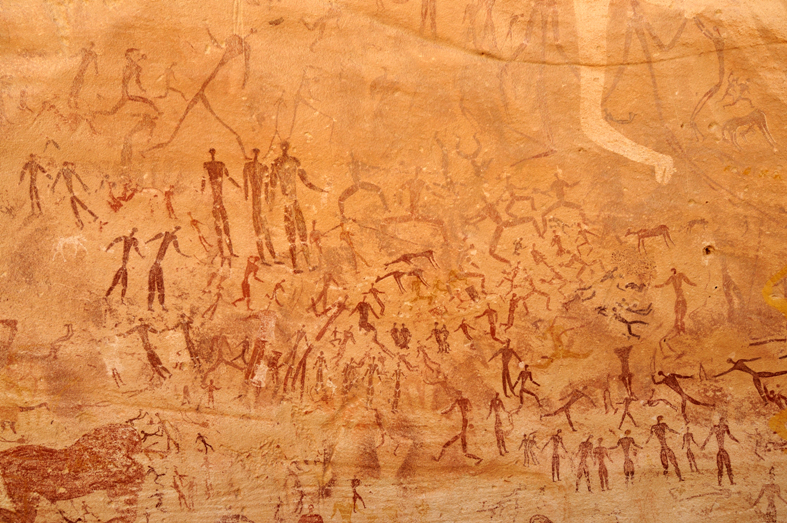
Due west of Swenet, modern day Aswan, there’s what’s called the Western Desert, covering approx. 700,000 km² of wasteland. In remote areas of this forbidding desert, such as Wadi Sura in Gilf Kebir and Nabta Playa, to name only two of the more prominent places, there are ancient petroglyphs as well as other signs of ancient culture to be seen. Paintings of animal herds, giraffes, ostriches, etc. – giving credence to the “savanna” geography and weather we spoke about above. Precipitation in ancient times is now conceded to have been approx. 500 mm per year.

Folks, 500 mm is half a liter, and half a liter of rain a year is not a lot of rain... even if one takes into account that globally averaged annual precipitation is 990 mm (39 in) over the entire surface of the planet during the course of a year. Lots of rain falls over oceans... 500 mm of rain is an average of 1.37 mm of rain per day.

Scientists, being rather dull herd-animals are not willing to stray too far from present conditions. They’ve given the Western Desert of Egypt half a liter of rain a year 12,000 years ago... Today the precipitation of the Libyan/Sahara desert is well neigh 0 mm/day. Can’t say they’re not generous with that half liter, given that it’s nearly half the annual average globally. And, a savanna type of geography can thrive with 1 to 2 mm of rain per day (averaged annually = 365 to 730 mm of rain).

Looking at things more broadly, these gracious scientists look rather chintzy... If there was greater precipitation during the last glaciation period (during the last 100,000 years of the Pleistocene, from approx. 110,000 to 12,000 years ago), then why would not rain continue, as it has in other areas where glaciers retreated? Although scientists admit that around 10,00 B.C. more rain fell, forming a lake in Nubia, for example, they still are not willing to conceive of a subtropical climate as a possibility...  


Rain, of course, is a major part of the story, but not the whole story... While sites in the Western Desert can easily predate 10,000 B.C., there are many more that are more recent. There is probably little doubt that precipitation was far greater before 10,000 B.C. than later, but that’s not to say that weather patterns repeat, and that over the millennia, many periods of abundant rain were possible even in the Sahara. Current theories say that those living in the Western Desert at that time were “pastoralists” – isn’t that a “nice” word? Peaceful pastoralists populated the plateaus... yeah, right!

So, now we know that they were raising sheep and cattle on a large scale (and on 500 mm of rainfall a year!). The key word is “large scale.” What did I tell you? You have a complicated management problem – a complex system you need run properly? Hire a pastoralist!

Agriculture and “pastoralism” are far older than we imagine, and certainly older than currently pegged by “scientists” (in the future they will be known as herd-animals, and isn’t that a nice “pastoral” way to put it?). Hey! Scientists have to be pastoralists – the big bad wolf is watching and when they don’t agree, the poor scientist get gobbled up – ala Little Red Riding Hood!

Speaking of rain... I’m sure no one has taken account of this fact... In ancient times, no self-respecting shaman, or magician, was unable to conjure rain at a moment’s notice... So much for annual precipitation averages!

You Always Take the Weather With You...

I got news for scientists all over this planet – human beings cause the weather. Our mere feelings, thoughts, and will, collectively, create the weather you enjoy (or not). This was how things have always been, only we’ve forgotten about it...

And, it’s not just “global warming” which is caused by humans – there’s a distinction between “deeds” or “activity” on the physical plane, and human beings causing climatic conditions to change through their other six senses. With respect to global warming, it is a simple question of Physics (I know, a subject no longer taught in school or university for a reason!). Our “activity” is the destruction of the material substances of this planet (we’re supposed to change every single molecule of carbon here), and the waste produced thereby.

Today’s herd-animal has no inkling that to every action there’s an equal and opposite reaction... Burning coal, like farting, has a “negative” and opposite reaction (read about these marvels in a Physics book, preferably one written in the 19th or early, early 20th Century, and convince yourself by trying it at home!). Btw, thank your tax dollars going to private education for that little bit of wisdom being lost, which explains why we have so many “deniers” around these days... especially in the press and on the tele...

I’d like to shove down the throat of one of these “denier” girlie-men a plateful of jalapeños, followed by another plate of refried beans (yeah, they can have a beer chaser, I’m not a waterboarder!). Then, after a few moments to let things “coalesce,” I’ll demonstrate, with the simple use of a lighter, what “global warming” looks like. When they fart, which they invariably will, the flame spewing out of their assholes usually does the trick. And, they have a hole in their trousers as a souvenir... Something to try on our politicians on national TV, me thinks... that’ll shut up all the hot air coming out of the other end of their asses!

I happen to think that the climatic conditions, as well as the geographical ones, in the Black Land, especially around 4,000 years ago, and before that time, were considerably different than what they are today. As we consider this question further, we have to take into account the fact that what remains behind as “relics” of a civilization for us to find are really only those things that were made when a civilization was “late” in its “life-cycle,” when it was already in decline (usually, a sharp curve downwards). Egyptologists believe that during the period of time when Khufu’s pyramid, the first of the great pyramids to be built (ca. 2580 B.C. to 2560 B.C.; i.e., some 4,596 years ago), was erected, the Black Land was already a vast desert like it is today.

Perhaps, since a civilization in decadence is one that has turned its environment into a desert.

At the juncture of the pyramids of Giza and the desert landscape which surrounds them, two riddles confront us. One is the age of the pyramids themselves, and the other is what geography and climate permitted the building of these monuments.

Before we get into the conundrum of the age of the pyramids, one would have to ask, what climate was conducive to their being built. Naturally, this brings into question many a priori judgments that have long been made about the Ancient Egyptians – the bad guys and anti-Semites of the ancient world par excellence. If one is inclined towards the modern view, then there’s a certain pathos in the evil pharaohs forcing the Jews to build the pyramids under the whip and under the blistering sun. But since no such fairy tale actually took place, the question remains... what climatic conditions would favor the building of the pyramids?

Since I don’t have a political ax to grind, my choice would be to deviate from the “convenient fable,” and the crass misreading of the Bible, and opt for mild, temperate weather, if not wet conditions (since water helps to alleviate not only thirst and replenishes fatigue, but also overcomes friction). And, since the Black People were not “slave drivers” how would it benefit them to kill their own people to build these monuments? (Esp. if one considers that these structures may have been built in thanksgiving for something!).

Naturally, this train of thought – that the Ancient Egyptians were not evil by nature – is anathema to the current crowd of herd-animals who support the historical lies current today, and which, of course, recommend it as the more likely scenario.

Today, the plateau of Giza is approx. 8 km. from the shores of the Great River. If geographic and weather conditions were exactly the same then as they are today, one would have to wonder why one would choose the Giza site to begin with. We know that many of the underlying sandstone was quarried locally, but a great deal of granite and limestone came from Swenet (Aswan) and that’s nearly 700 km. away. But it’s the last 8,000 meters, from the boat to the construction site, that’ll kill you (an analogy can be made with the telephone system in the last century, wherein the wiring of copper from the box to the home was the hardest and most time consuming to install).

Would it not have been better to build the pyramids closer to the Nile? Even if during the Inundation, water covered their base, the pyramids would not have been worst for the wear... The Ancient Egyptians certainly had no prejudice against building monuments within the flood area of the Great River – the great statues of Amunhotep III on the west bank of Waset (Thebes) attest to that. So why so far from the Nile?

In my opinion, it must have been because the Giza plateau must have been the riparian boundary of the Nile, at least during the Season of Inundation, which is when the actual work was done on the project – be it in 2580 B.C., as the orthodox Egyptologists are paid to believe, or much, much earlier, as most intelligent people surmise. Which brings us to how much more water volume must have been flowing through the Nile in order to make its main channel wider than it is today... It either rained a lot more in Equatorial Africa, or it also rained all along the Great River’s long length so that the watershed accumulated far more water than in recent memory (and I mean memory before the building of the Aswan High Dam and the filling of Lake Nasser, which killed the river by ending its perennial flooding).

A wider river channel would also increase fertile land, extending the “green belt” of the Great River into what otherwise is believed to be an arid, inhospitable desert. This green belt most likely consisted of several square kilometers of forested areas (not only shade, but fuel was needed to sharpen chisels, and forge tools). There were many “tree planting” pharaohs, such as Senusret III (Middle Kingdom), that have been mentioned in the record, and it’s likely that a “policy” of reforestation was always in place (as if Black People had to think twice about doing what’s needed!).

We may not be able to imagine a tree lined, forested expanse on both sides of the Nile, but it most certainly was there 5,000 years ago. How did that “green belt” affect the weather? That would certainly be a “human activity” that would have cooled matters on the ground... In any case, there’s a lot more to this subject of changing climate and geography, which we’ll have to take up in the near future, since there’s a lot more here than meets the eyes...